


In order to determine whether you have fungus on your toenails and quickly fight the disease, you need to know the signs of its appearance.It has been found that about 20% of the world's population is infected with onychomycosis.People who exercise and go to the swimming pool fall into the risk category.
Reasons for the development of onychomycosis
Given this problem, the question arises as to why nail fungus occurs on the hands or feet.The pathogens thrive in the soil or in the air.The best conditions for their reproduction are excessive humidity and a significant increase in temperature (public showers).
Nail fungus on fingers or toes is an infectious disease and can therefore develop very quickly.The human nail plate is porous, it contains water, keratin fibers and fat.Therefore, having created suitable conditions for the reproduction of pathogenic microorganisms, one should soon expect the appearance of unpleasant lesions.

The main causes of nail fungus are:
- Wear tight shoes.Poorly breathable products made from inferior materials are particularly dangerous.
- When a person suffers from excessive sweating.
- Significant dysfunction of the patient's immune system occurs.Onychomycosis can occur due to changes in hormonal levels or due to dysfunction of metabolic processes.
- Often the disease occurs after using non-sterile manicure instruments.
- After a long therapy with antibacterial drugs.
- As a concomitant disease of diabetes mellitus or varicose veins.
- Due to bad habits as well as work characteristics.
Symptoms of a fungal disease on the feet
To recognize toenail fungus, you need to know its symptoms.The primary signs of the disease are excessive dryness, flaking and regular itching of the skin.Unfortunately, these symptoms are almost always ignored.After some time, changes on the nail surface become noticeable.Instead of shine and healthy color, cracks and sometimes depressions form.But even such obvious signs are often ignored.
Typically, patients whose fungal infection has progressed are seen by a doctor.In this case, the nail plate changes color completely, the nail becomes brittle and can then even peel off.
If the disease is not treated in time, the risk of the fungal infection spreading to the skin increases.And due to the bad habit of biting nails, the disease manages to invade the human body and affect internal organs (if the patient suffers from fingernail fungus).
To avoid serious complications, it is important to diagnose the disease in a timely manner.It is better to start fighting the fungus in the early stages.You can diagnose a fungal infection yourself.To do this, you need to prepare a potassium permanganate solution at home and then dip your feet in it.Healthy plates are characterized by an even, more brown color.And nails affected by onychomycosis are white.
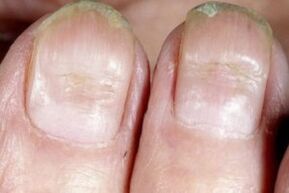
There are several ways to recognize nail fungus yourself:
- There is a significant deformation of the nail plate.You should not ignore signs that the color of the nail changes or a slight thickening of the nail occurs.The presence of infection is also indicated by unusual spots of different colors.
- Changes in the nail structure have occurred.Onychomycosis cannot only be diagnosed based on unusual spots.Sometimes veins and stripes appear on the nail plate.Without timely treatment, they spread and then affect the skin of the legs.
- If the nail comes off.Due to a fungal infection, the plate begins to crumble and sometimes peels off.
- Instead of a healthy color, the nail becomes dull yellow.At the same time, the edges of the rollers become inflamed and become hypersensitive.
- The death of the tissue creates an unpleasant smell.
- If the fungus on the legs has already developed into an advanced stage, pain occurs when walking or when pushing.
Characteristics of some fungal infections
Before therapeutic treatment of onychomycosis, it is necessary to determine exactly which type of pathogen has affected the nails.This requires careful diagnosis.Although the symptoms of a fungal infection are similar, there are some peculiarities in the course of the disease.
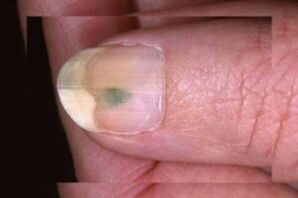
If the pathogen is yeast, the patient's nail turns dull yellow and becomes very dense.It also comes off the bed.
However, if it is determined that the fungus was caused by mold, the symptoms are manifested by a color change (sometimes green, brown, and sometimes black).In addition, the plate begins to peel off significantly and numerous inclusions form on it.
Sometimes a fungal infection occurs due to the activity of dermatophyte pathogens.The disease is manifested by longitudinal stripes located in the middle or along the edges of the nails.
You shouldn't self-medicate.Instead, it is recommended to consult a specialist.Only the attending physician will determine how to recognize the causative agent of onychomycosis and prescribe the optimal method of therapy.
The process of getting rid of an illness is always long.However, with the help of special ointments, unpleasant symptoms disappear from the skin after 3 weeks.In certain cases, treatment for a fungal nail infection may take several months.In addition to following the specialist's instructions, you also need to pay attention to hygiene.Foot baths with the addition of apple cider vinegar bring excellent results.
It is recommended to regularly treat the affected areas with tea tree oil or use a special propolis tincture.
It is possible to prevent reinfection with onychomycosis.You must understand that for this each family member must have their own hygiene items.Also do not forget to regularly treat the inside of your shoes with special alcohol.